
Hip vs. Gable Roofs: A Complete Guide for Homeowners
Table of Contents
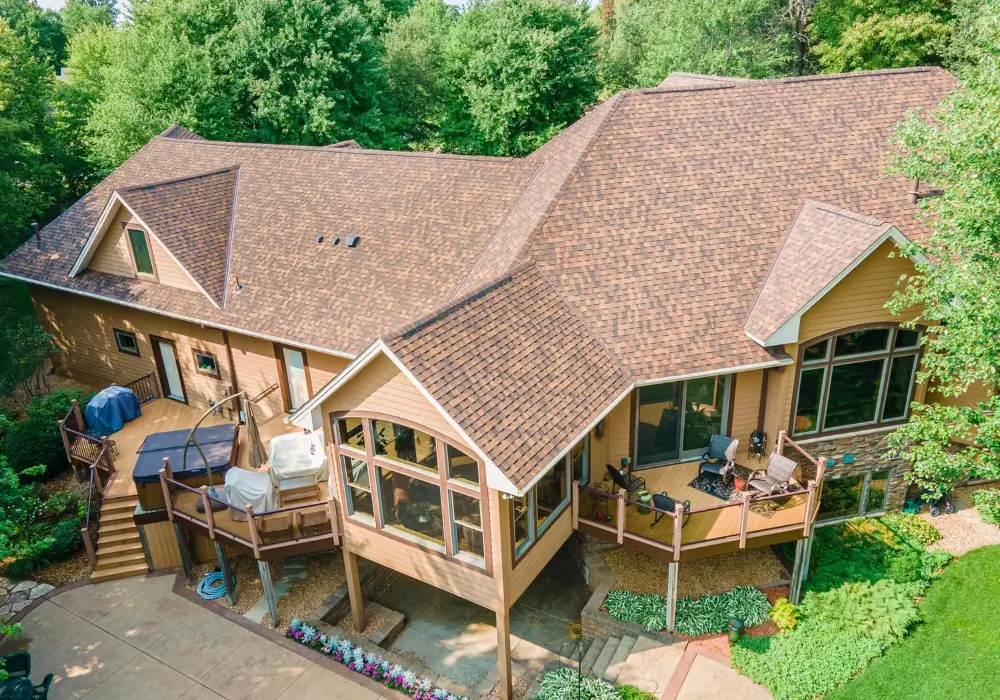
When designing or renovating a home, choosing the right roof style is more than an aesthetic decision—it affects durability, weather resistance, maintenance costs, and even property value. Two of the most common and practical roof designs are the gable roof and the hip roof. If you’ve ever noticed a house with a classic triangle shape at the top, that’s a gable roof. In contrast, a hip roof slopes down on all four sides and is known for its stability and wind resistance.
Whether you’re planning a home extension, building a garage, or simply trying to understand which roof style suits your climate and budget, this guide will help you make an informed decision. We’ll break down the differences between hip and gable roofs, their advantages, disadvantages, structure, cost considerations, and which one is best for your home.
The Difference Between a Hip Roof and a Gable Roof
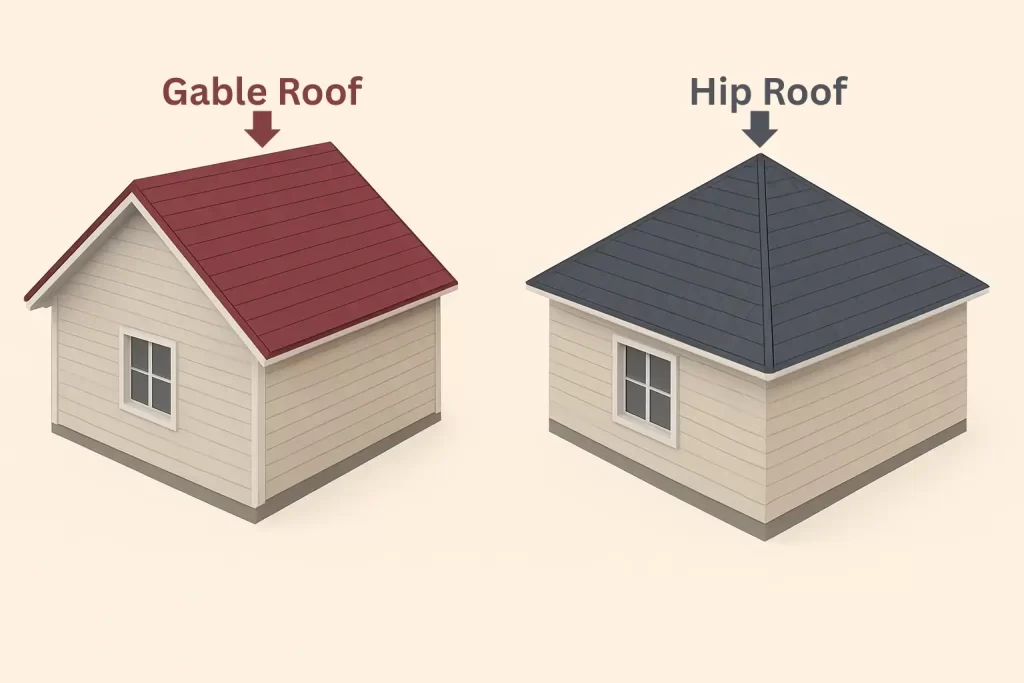
When choosing a roof style for your home or new construction project, hip roofs and gable roofs are two of the most common options. While both are visually appealing and functional, they differ in structure, performance, and suitability for different climates.
What is a Gable Roof?
A gable roof is characterized by two sloping sides that meet at the top ridge, forming a triangular wall section at each end of the house. This triangular portion is known as the gable. Because of its simple design, it is often recognized as the classic “triangle-shaped” roof.
What is a Hip Roof?
A hip roof, on the other hand, slopes downwards on all four sides—without any vertical or flat ends. All the sides meet at the top to form a ridge, and the lines where the roof slopes connect are called hips. This design provides a more enclosed and wind-resistant structure.
Key Structural Differences
Feature | Gable Roof | Hip Roof |
Roof Sides | Two sloping sides | Four sloping sides |
Vertical Walls | Two flat triangular gables at the ends | No vertical ends; all sides slope down |
Shape | “A”-shaped front or back | Pyramid-like or ridge-top design |
Roof Intersection | Single ridge line | Multiple hips and one ridge line |
Attic Space | More usable space, good for ventilation | Less attic space due to inward slopes |
Different Types of Hip Roofs
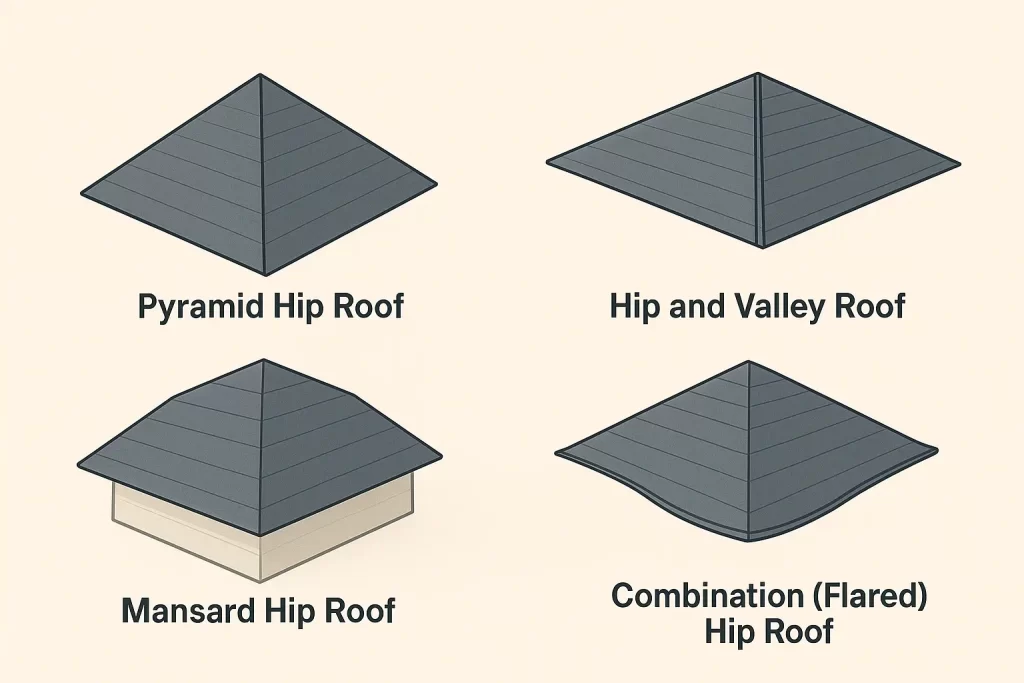
Hip roofs come in several design variations, each offering its own aesthetic appeal, structural benefits, and practical use. While all hip roofs share one common feature—sloping sides on all four faces—their shapes and construction can vary depending on architectural needs. Here are the most popular types of hip roofs homeowners should know about:
1. Pyramid Hip Roof
A pyramid hip roof, also known as a square hip roof, features four equal-sized triangular roof panels that meet at a single point at the top, forming a pyramid shape.
Best for: Small structures like gazebos, pavilions, pool houses, or compact homes.
Why it’s popular: Simple, symmetrical design with good wind resistance and efficient water drainage.
2. Hip and Valley Roof
A hip and valley roof is commonly used for homes with complex layouts or L-shaped and T-shaped floor plans. It combines multiple hip roof sections, creating valleys where two roof slopes intersect and angle downward.
Best for: Larger homes or multi-wing buildings.
Advantages: Adds architectural depth and increases water drainage efficiency.
Considerations: A more complex structure means higher construction and maintenance costs.
3. Mansard Hip Roof
Inspired by French architecture, the mansard hip roof features two slopes on each of its four sides—the lower slope is steep and more visible, while the upper slope is shallow.
Best for: Homes needing extra living or attic space (can be converted into a loft or additional floor).
Benefits: Creates more usable interior space and adds a traditional, elegant look.
Note: Complex framing makes it costlier and less suitable for areas with heavy snowfall.
4. Combination Hip Roof (Flared or Dutch Hip Roof)
A combination or flared hip roof has a subtle outward curve or flared edge along the lower portion of the roof. This design is the opposite of a mansard roof—here, the roof flares outward at the base instead of having a steep lower slope.
Best for: Homes aiming for a decorative touch or improved shading around the perimeter.
Benefits: Enhances curb appeal, provides better rain run-off, and shields exterior walls from water damage.
Quick Comparison of Hip Roof Types
Hip Roof Type | Defining Feature | Best For | Key Advantage |
Pyramid Hip Roof | Four equal sides meet at a point | Gazebos, small homes | Simple, great wind resistance |
Hip and Valley Roof | Valleys where roof planes intersect | Large or complex homes | Elegant design, good water flow |
Mansard Hip Roof | Double-sloped on each side | Extra living space | Adds usable attic/loft area |
Combination (Flared) | The roof flares out at the bottom | Aesthetic appeal | Stylish, adds wall protection |
Combining Hip and Gable Roofs: Can It Be Done?
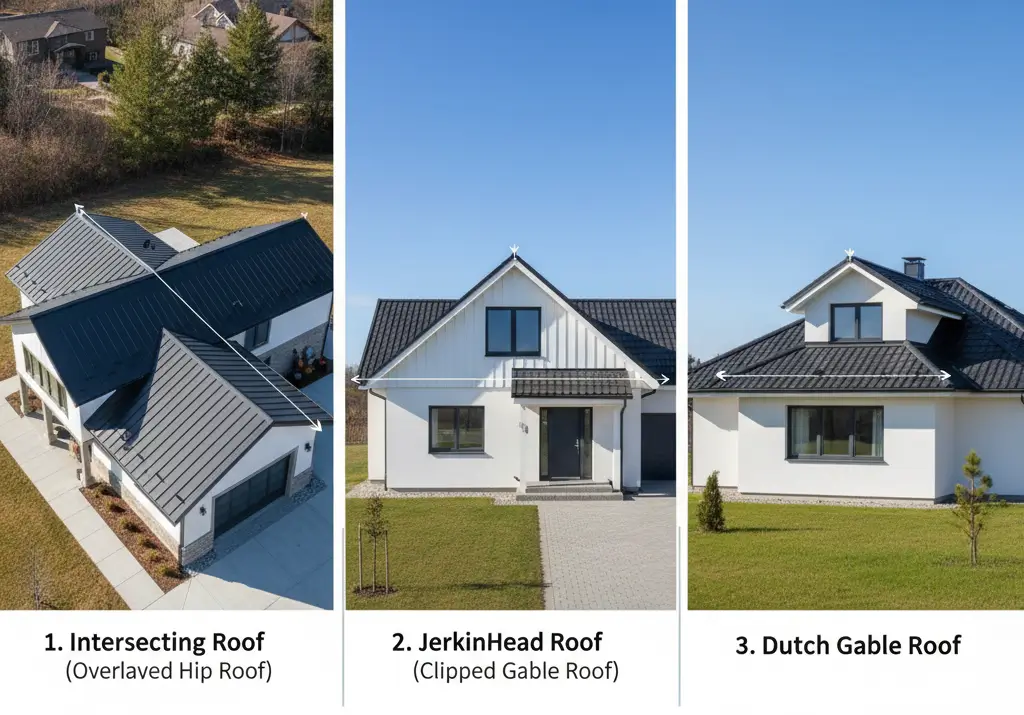
Yes—homes can absolutely feature both hip and gable roof designs in one structure. In fact, many modern and traditional architectural styles blend the strengths of both roof types to create better aesthetics, improved durability, and more usable interior space. These hybrid roofs not only add visual interest but also enhance functionality, especially for complex home layouts.
Below are the most common roof styles that successfully combine hip and gable structures:
1. Intersecting Roof (Overlaid Hip Roof)
An intersecting or overlaid hip roof looks like a hip roof has been placed over a gable roof at a 90-degree angle. This design is commonly used on homes with T-shaped or L-shaped layouts.
Key Features:
- Two roof sections intersecting at right angles
- Offers strong structural support and improved rainwater drainage
- Adds depth and dimension to the home’s exterior
2. Jerkinhead Roof (Clipped Gable Roof)
A jerkinhead roof starts as a standard gable but has the top of the gable clipped or “cut off” and replaced with small hip-like slopes. This short, angled section reduces wind pressure on the roof.
Key Features:
- Partial hip at the top of the gable
- Better wind resistance than traditional gable roofs
- Classic yet highly functional design
3. Dutch Gable Roof
A Dutch gable roof combines the lower structure of a hip roof with a small gable at the peak. In other words, it’s the opposite of a jerkinhead roof—the gable sits on top, while the hips extend below.
Key Features:
- Gable section at the top for attic ventilation or window placement
- Hip roof at the bottom for stability and wind resistance
- Ideal blend of style, space, and strength
Why Combine Hip and Gable Roofs?
Advantage | Description |
Improved Aesthetics | Hybrid roofs add architectural character and a more dynamic roofline. |
Better Wind Resistance | Hip elements provide stability in strong winds, while gables offer ventilation and attic space. |
Enhanced Usable Space | Gable portions can accommodate attic rooms, windows, or storage. |
Custom Design Flexibility | Perfect for homes with irregular floor plans or multiple extensions. |
Things to Consider Before Combining Roof Styles
- Higher Construction Cost due to complex framing and additional materials
- Requires Skilled Roofing Contractors for proper sealing and structural integrity
- Potential for Water Leaks at intersecting joints if not designed and flashed correctly
Maintenance Can Be Slightly Higher because of more valleys, ridges, and joints.
Comparison Between Hip and Gable Roofs
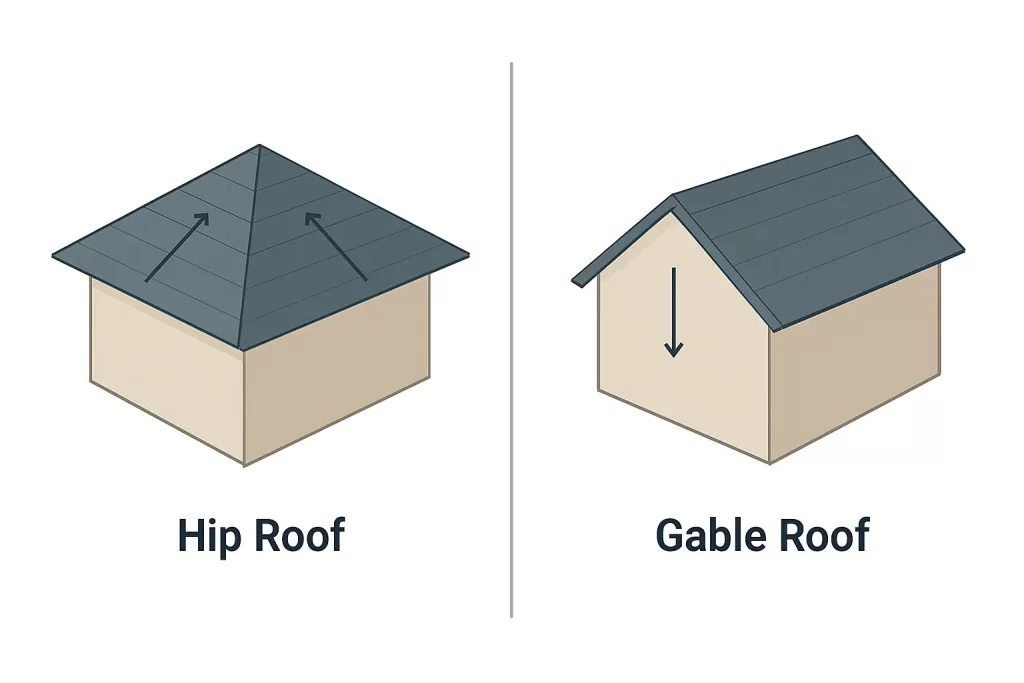
Choosing between a hip roof and a gable roof involves more than just aesthetics—it impacts cost, weather performance, attic space, and even long-term maintenance. Below is a clear comparison to help you understand the core differences and make the right decision for your home.
Hip Roof vs Gable Roof: Quick Comparison Table
Feature | Hip Roof | Gable Roof |
Wind Performance | Excellent — slopes on all four sides provide better resistance to strong winds and hurricanes | Fair — open gable ends can catch wind, making them less stable in storm-prone regions |
Snow & Rain Handling | Moderate — can shed water well, but snow may accumulate more in low-pitched hip designs | Excellent — steep slopes allow snow and rain to slide off easily |
Construction Cost | Higher — more materials and complex framing required | Lower — simple, cost-effective structure |
Ease of Construction | More complex and time-consuming | Easier to build with a straightforward design |
Attic or Ceiling Space | Limited — inward slopes reduce attic size | More attic space and better storage potential |
Ventilation | Less natural ventilation due to fewer gable ends | Better ventilation with open gable ends and vent options |
Home Insurance Benefits | May qualify for lower insurance premiums in high-wind areas | Typically no insurance discounts unless upgraded |
Aesthetic & Design Options | Offers a smooth, symmetrical look but limited decorative options | Allows for decorative elements like window gables, trim, and overhangs |
Advantages and Disadvantages of Hip Roofs
Hip roofs are a popular choice for modern and traditional homes due to their balanced structure and clean aesthetics. However, like any roofing style, they come with both benefits and challenges. Below is a complete breakdown to help homeowners make an informed decision.
Advantages of Hip Roofs
1. Excellent Wind Resistance
Hip roofs perform exceptionally well in high-wind and storm-prone regions.
- Their four sloping sides create an aerodynamic shape that reduces wind pressure.
- Unlike gable roofs, they don’t have flat vertical ends where strong winds can catch and cause uplift.
- Wind tunnel studies show that square hip roofs with equal slopes offer superior wind stability.
Best for: Coastal areas, hurricane zones, open landscapes.
2. Structurally Stable and Easy to Build
From a builder’s perspective, hip roofs are structurally balanced.
- All exterior walls are the same height, simplifying the framing process.
- They require less diagonal bracing compared to gable roofs.
- While they use more materials, many builders find the construction process straightforward.
3. Better Drainage
With slopes on all four sides, rainwater naturally flows down toward the eaves. This minimizes the risk of water pooling and roof leaks, especially in areas with frequent rainfall.
4. Aesthetic Appeal
Hip roofs provide a clean, symmetrical look that complements a wide range of architectural designs—from ranch-style and Mediterranean homes to modern builds.
Disadvantages of Hip Roofs
1. Lower Snow Handling Capability
Although water drains well, snow can be a concern.
- Hip roofs often have a lower pitch than gable roofs, which means snow may sit longer on the surface.
- In heavy snowfall regions, they require proper design to meet local snow load standards.
- Ice and water shield membranes are recommended for additional protection.
2. Limited Attic or Interior Space
Due to the inward slopes and the need for diagonal bracing:
- Hip roofs offer less attic space compared to gable roofs.
- Vaulted ceilings are harder to achieve.
- However, adding dormers can increase natural light and usable space.
3. Higher Cost
When compared to gable roofs, hip roofs are more expensive to build and maintain.
- More roofing materials and specialized framing are required.
- The design is slightly more complex, which can increase labor costs.
- Long-term maintenance may also cost more due to additional ridges and valleys.
Top Gable Roof Types and Their Features
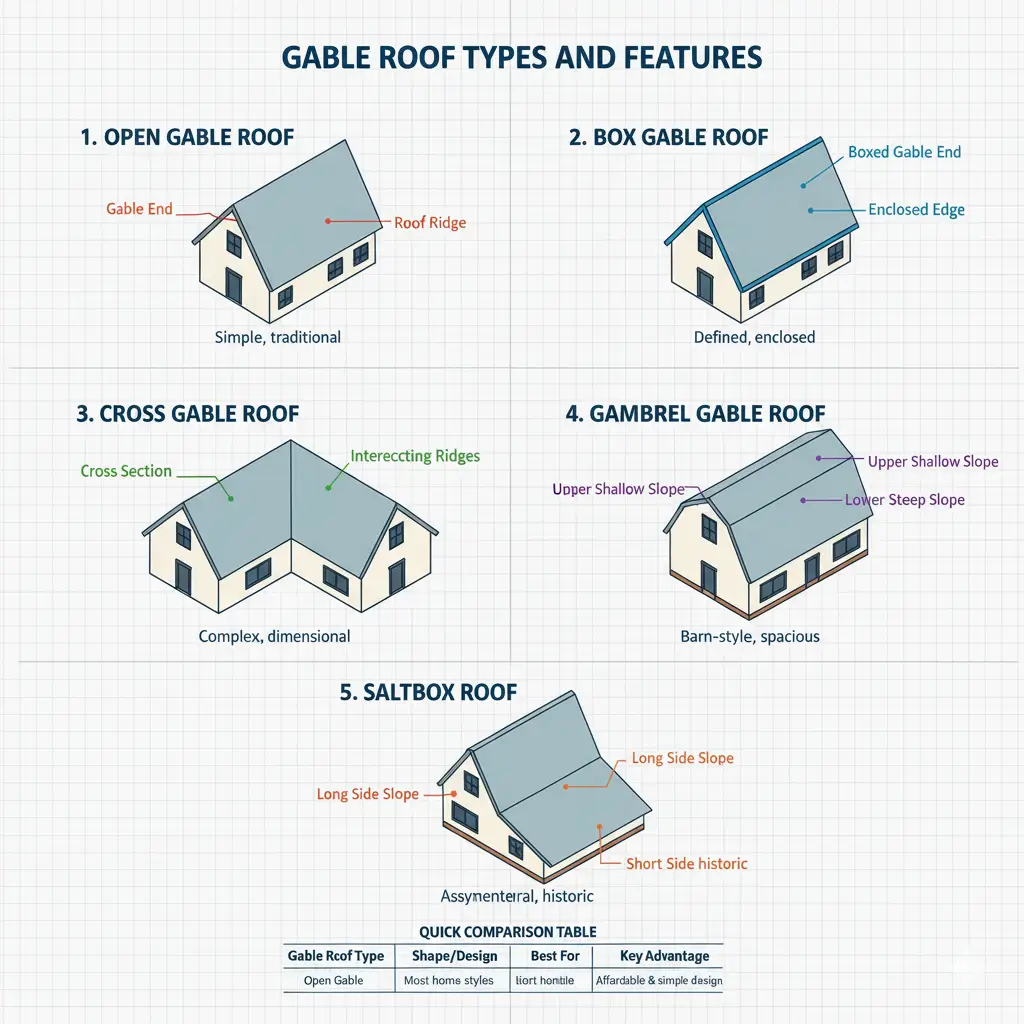
Gable roofs come in a variety of styles that can enhance both the functionality and visual appeal of a home. While the classic gable roof features two sloping sides that form a simple triangular shape, different variations offer unique structural and aesthetic benefits. Below are the most popular types of gable roofs and what makes each one stand out.
1. Open Gable Roof
The open gable roof is the most traditional and widely recognized style. It has two sloping sides and a fully visible triangular gable at each end, usually finished with the same siding material as the house.
Best for: Traditional homes, modern farmhouse designs
Key Features:
- Simple structure and cost-effective framing
- Excellent ventilation and attic space
- Ideal for areas with rain and snow due to effective water drainage
2. Box Gable Roof
A box gable roof is similar to an open gable but with one key difference: the triangular gable end is boxed in, creating a more defined and enclosed look.
Best for: Homes seeking a clean, finished appearance
Key Features:
- Enclosed gable edges for added weather protection
- Stronger structural support at the roof ends.
- Enhances curb appeal with a sharp, angular profile
3. Cross Gable Roof
A cross gable roof is made by intersecting two or more gable roof sections at right angles. This style is common in homes with complex layouts or multiple wings.
Best for: Multi-story houses, large floor plans, Tudor and Victorian-style homes
Key Features:
- Adds dimension and architectural interest
- Allows for separate interior rooflines—ideal for different room designs
- May require more complex framing and higher installation costs
4. Gambrel Gable Roof
Often seen on barns and colonial-style homes, the gambrel roof resembles a mansard roof but in a gable form. Each side has two slopes—one steep and one shallow—creating more usable upper space.
Best for: Barns, farmhouses, loft-style homes
Key Features:
- Maximizes attic or loft space
- Traditional, rustic aesthetic
- Not ideal for high-wind areas due to wide roof overhangs
5. Saltbox Roof
The saltbox roof is an asymmetrical version of the gable roof—one side is longer than the other, creating a long slope on one side and a short slope on the other.
Best for: Colonial and historic-style homes
Key Features:
- Sloped design helps rain and snow slide off easily.
- Creates additional living space on one side of the home
- Unique historic charm, but complex framing and uneven ceiling heights
Quick Comparison Table
Gable Roof Type | Shape/Design | Best For | Key Advantage |
Open Gable | Classic triangle | Most home styles | Affordable & simple design |
Box Gable | Enclosed gable end | Modern/traditional homes | Enhanced durability & style |
Cross Gable | Multiple gable sections intersect | Large, complex homes | Architectural character |
Gambrel | Double-sloped gable sides | Barns, farmhouses | Extra space/loft potential |
Saltbox | Asymmetrical gable roof | Colonial-style homes | Extra interior space & charm |
Choosing the Right Materials for Your Gable Roof
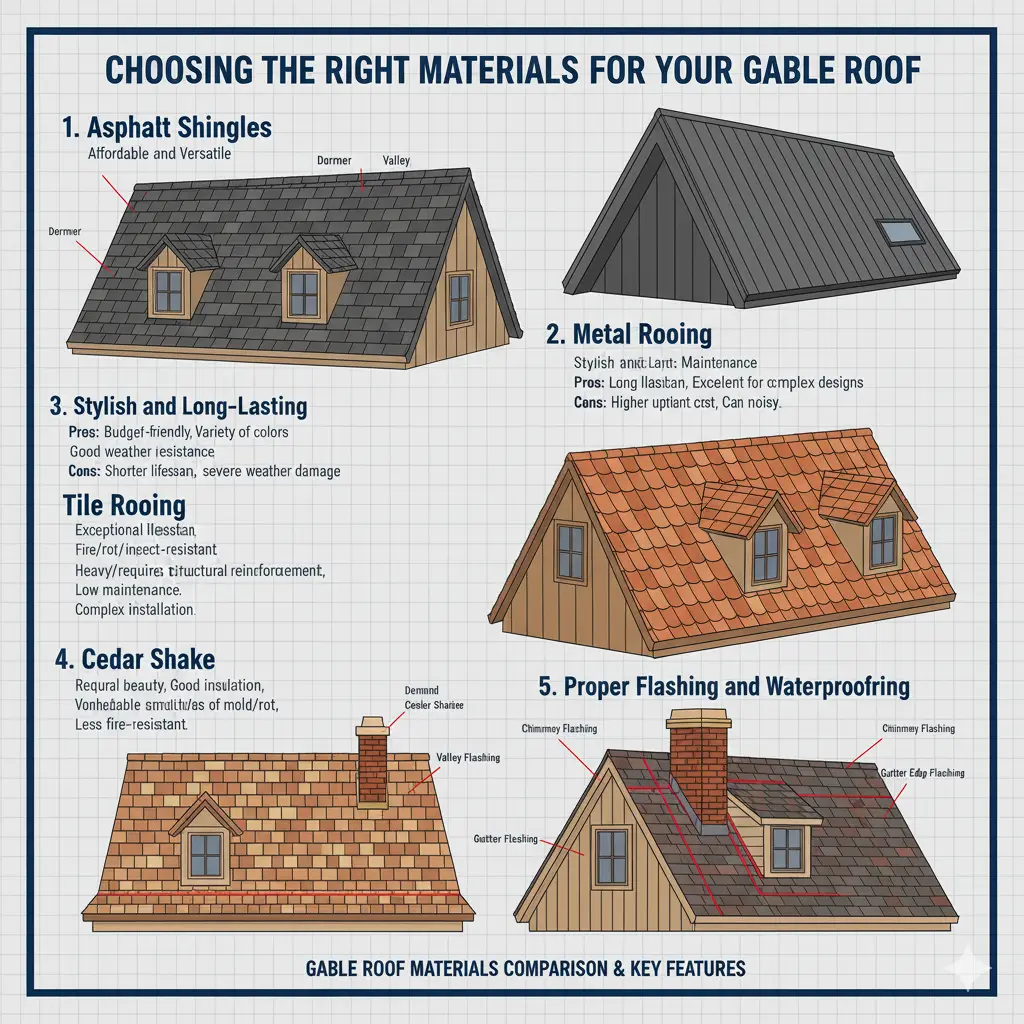
Selecting the right roofing material for a gable roof doesn’t just impact the appearance of your home—it also affects durability, maintenance, energy efficiency, and long-term cost. Since gable roofs are versatile and compatible with many materials, it’s important to understand the benefits and drawbacks of each option before making a decision.
1. Asphalt Shingles – Affordable and Versatile
Asphalt shingles are the most common choice for gable roofs due to their cost-effectiveness, ease of installation, and wide design options. They work especially well on gable roofs with dormers, hips, or valleys, as they provide reliable leak protection when installed properly.
✔ Pros:
- Budget-friendly and easily available
- Variety of colors and styles to match any home
- Good weather resistance
✖ Cons:
- Lifespan is shorter compared to metal or tile
- Can be prone to damage in severe weather if not maintained
2. Metal Roofing – Strong and Low Maintenance
Metal is an excellent choice for homeowners looking for durability and high weather resistance. Whether in the form of metal shingles or a standing seam roof, it withstands strong winds, heavy rain, snow, and temperature extremes.
✔ Pros:
- Long-lasting and durable
- Minimal maintenance required
- Excellent for complex gable designs with peaks and valleys
✖ Cons:
- Higher upfront cost compared to asphalt
- It can be noisy during rain or hail unless soundproofing is added.
3. Tile Roofing (Clay, Concrete, or Terra Cotta) – Stylish and Long-Lasting
Tile is one of the most durable roofing options, often lasting 60 to 100 years with proper care. These tiles are fire-resistant, weather-resistant, and great for hot climates. However, they are much heavier than other materials and require strong support structures.
✔ Pros:
- Exceptional lifespan and timeless aesthetic appeal
- Resistant to fire, rot, and insects
- Low maintenance once installed
✖ Cons:
- Heavy—may require structural reinforcement
- Installation is more complex and expensive.
4. Cedar Shake – Natural and Attractive
Cedar shake roofs give gable homes a rustic, warm appearance and perform well in areas with dormers or roof intersections because they naturally resist leaks in these tricky areas.
✔ Pros:
- Natural beauty and enhanced curb appeal
- Good insulation properties
- Works well around dormers and roof peaks
✖ Cons:
- Requires regular maintenance (cleaning, sealing)
- Vulnerable to mold, rot, and water damage if neglected
Less fire-resistant unless treated
5. Don’t Forget Proper Flashing and Waterproofing
Gable roofs often feature dormer windows, valleys, chimneys, gutters, and varying roof heights, which are common areas for leaks. No matter which roofing material you choose, proper flashing installation—thin sheets of metal placed around edges and joints—is essential to prevent water damage.
Flashings should be installed around:
- Dormer windows
- Chimneys
- Valleys and roof intersections
- Gutters and roof edges
Advantages and Disadvantages of Gable Roofs
Advantages of Hip Roofs
1. Cost-Effective Design
One of the biggest reasons homeowners choose gable roofs is their affordability. Since a standard gable roof only uses two sloping panels—unlike hip roofs, which require four—less roofing material and labor are needed. Although you may spend slightly more on siding for the gable ends, it is still a more budget-friendly choice overall.
2. Better Attic Space & Usability
Gable roofs naturally create more vertical space in the attic. This extra headroom can be used for storage, an additional bedroom, a playroom, or even a home office. Instead of being wasted space, a gable attic can become a functional part of the home.
3. Improved Ventilation Options
Good roof ventilation helps control moisture, temperature, and overall roof health. Gable roofs can easily accommodate gable vents, which allow airflow through the attic. While opinions differ on how effective gable vents are on their own, they can work well when combined with ridge vents and soffit vents for a balanced ventilation system.
4. Aesthetic Flexibility & Design Appeal
From modern homes to classic cottages, gable roofs add a timeless architectural look. They also offer more room for decorative elements such as gable brackets, pediments, or custom trim. These details can enhance curb appeal and complement various design styles—modern, rustic, or traditional.
Disadvantages of Gable Roofs
1. Poor Wind Resistance
Gable roofs are more vulnerable to strong winds compared to hip roofs. The flat triangular side (the gable end) can catch wind pressure directly. In severe storms, excessive force on poorly constructed gables may cause roof damage, especially if the overhang is too long. In high-wind zones, keeping the overhang under 30 inches and reinforcing the structure is highly recommended.
2. More Complex to Build
Gable roofs may seem simple, but they require careful planning and skilled construction. The walls need to be built at varying heights to support the roof shape. In windy areas, additional bracing or supports may be required, which increases labor time and construction difficulty.
3. Ventilation Limitations if Not Properly Designed
While gable vents can help with ventilation, they are not always sufficient on their own—especially for large homes. Ridge vents combined with soffit vents often provide more balanced airflow. So, choosing a gable roof just for ventilation benefits isn’t always necessary, as any roof type can be ventilated properly when done by an experienced professional.
Bonus Insight: Reverse Gable Roofs (For Garages)
A reverse gable roof places the gable on the side of the garage rather than the front with the door. This design provides:
- More overhead storage space compared to hip roof garages.
- Flexible gutter placement prevents water from flowing toward the driveway.
- A wider but shorter garage structure that accommodates one or two garage doors without extending too far outward.
Frequently Asked Questions (FAQs)
A gable roof has two sloping sides that meet at a ridge, creating a triangular wall at each end. A hip roof has four sloping sides and no vertical gable wall. Because of this, hip roofs are more stable in high winds, while gable roofs are more affordable and offer better attic space and ventilation.
Yes, gable roofs perform well in areas with heavy rain or snow because their steep slope allows water and snow to slide off easily. However, they must be properly built to prevent wind uplift in storm-prone regions.
Gable roofs are generally more cost-effective. They require fewer materials, are simpler to design, and take less time to build. Hip roofs are more expensive due to their complex structure and additional materials needed for construction.
Yes, hybrid designs like Dutch gable roofs or intersecting roofs combine both hip and gable elements. These designs offer better curb appeal, improved strength, and additional attic or living space while maintaining efficient drainage.
Gable roofs offer more usable attic space and better natural ventilation because of their triangular shape and open ends. Hip roofs, while stronger, have limited attic space and may require additional ventilation systems to ensure proper airflow.